Endangered parrot eggs hatch after smuggling arrest at Johannesburg airport
Fifty endangered parrot eggs, seized from a Thai suspect at OR Tambo Airport, have hatched under expert care in Pretoria, highlighting South Africa's fight against wildlife trafficking.
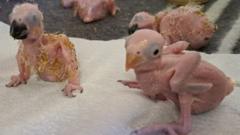
A 50‑year‑old Thai national was arrested at Johannesburg’s OR Tambo International Airport on Thursday after customs officials seized 50 eggs believed to belong to an endangered parrot species. The eggs were found in a homemade incubator bag carried as hand luggage, the Department of Forestry, Fisheries and the Environment (DFFE) said.
The seized eggs have begun to hatch. Staff at the National Zoological Garden in Pretoria are now caring for the chicks, providing intensive care to maximise their chances of survival, the DFFE added.
If found guilty, the suspect faces a fine of up to 10 million rand (about $626,000) or up to 10 years in prison, or both. Initial investigations suggest the eggs belong to a species protected under the Convention on International Trade in Endangered Species of Wild Fauna and Flora (CITES).
The arrest followed a joint operation by the DFFE, the Green Scorpions – a specialised environmental enforcement unit – and several police divisions. Environment Minister David Maynier congratulated the agencies involved, saying, “illegal wildlife trafficking can only be challenged by a co‑ordinated defence of our natural heritage.” He also thanked the staff at the National Zoological Garden, noting that they “have been working tirelessly to incubate the seized eggs and provide specialised care to the hatchlings.”
The incident is part of a growing pattern of sophisticated transnational wildlife‑trafficking networks. In July, a 23‑year‑old Thai citizen was arrested at the same airport for attempting to smuggle 418 parrot eggs. The DFFE said the arrests underline the importance of coordinated, intelligence‑led law‑enforcement efforts.
Wildlife trafficking remains a major threat in South Africa, a country with one of the world’s highest levels of biodiversity. Criminal networks target a range of species, from elephants and pangolins to birds, for sale on the international black market. The illegal collection and trafficking of parrot eggs poses a “serious threat to wild bird populations and animal welfare,” the DFFE said, noting that such eggs are often smuggled in improvised incubators under conditions that endanger the welfare of developing embryos and hatchlings.
To combat the threat, South Africa adopted a new strategy six years ago to strengthen collaboration among government institutions, law‑enforcement agencies, conservation authorities, customs officials, prosecutors and international partners. The goal is to dismantle criminal networks involved in the illicit wildlife trade.
The National Zoological Garden in Pretoria has been monitoring the eggs and hatchlings since the interception. The staff’s efforts are now ensuring that the chicks receive the necessary veterinary and nutritional support to thrive in captivity.
The case highlights the ongoing challenge of protecting endangered species from illegal trade and the importance of international cooperation in enforcing wildlife‑conservation laws.
Comments (0)
No comments yet — be the first to weigh in.

NASA Launches Nancy Grace Roman Telescope to Unlock Universe's Mysteries
NASA's new Nancy Grace Roman Space Telescope lifts off from Florida to study dark energy, exoplanets, and cosmic mysteries with unprecedented precision and scope.

Nature reserves spot rare species during heatwaves
Nature reserves in Hertfordshire and Middlesex have documented rare species this summer, with volunteers spotting wildlife not seen in decades and some even for...

Inmates at HMP La Moye craft boxes to save Jersey's hedgehogs
Prisoners at HMP La Moye have crafted nesting and feeding boxes to support Jersey's hedgehog population, boosting rehabilitation and community engagement.

2026 Nepal Flood: Ice‑Rock Avalanche, Glacial Lake Outburst and Climate‑Change Risks
A massive ice‑rock avalanche triggered a catastrophic flood in Nepal on Aug. 26 2026, followed by a glacial lake outburst that devastated towns and hydropower plants. Climate‑change‑driven thawing increased the risk.

Mumbai’s Vile Parle Cypher is giving unheard rappers a voice

Enrich and Ultimo impress

Karnataka CM Signals Review of 5% Park Land Amendment Bill in Assembly

