Ghana Leads Global Push for Slavery Reparations Amid UN Backlash
Ghana is spearheading international demands for slavery reparations, hosting a UN-backed summit and calling for accountability from historical beneficiaries, despite Western resistance.
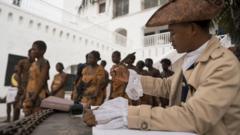
Ghana has emerged as the leading African voice advocating for slavery reparations, pushing for accountability from nations and institutions that benefited from the trans-Atlantic slave trade. The West African nation hosted an international reparations summit in June, featuring a re-enactment of slavery at Christiansborg Castle in Accra, a former slave-trading post. This follows a March United Nations resolution—opposed by the U.S. and with abstentions from European states—that declared slavery the “greatest crime against humanity.”
Foreign Minister Samuel Okuzeto Ablakwa has framed Ghana’s role as both historical and moral. As the first sub-Saharan African country to gain independence, Ghana has been designated by the African Union as the continent’s “champion for reparatory justice.” Speaking to international delegates, Ablakwa emphasized Ghana’s historical burden: “Ghana was the crime scene where these atrocities took place,” he said, noting that 10 to 15 percent of the 12 million Africans forcibly removed during the trans-Atlantic trade originated from what is now Ghana.
The June summit in Accra, attended by representatives from about 80 countries, concluded that reparations are long overdue. Ablakwa is calling for a reparatory justice system that includes educational grants, venture capital for young African entrepreneurs, and research into long-term health effects linked to slavery. He also supports debt relief for affected nations. “This is not about direct financial gain for African leaders,” he stated, “but about systemic justice.”
Among the institutions facing calls for accountability is the Church of England. Historical records show that in the 18th century, the Church’s missionary arm operated plantations and owned hundreds of enslaved people, generating wealth that funded its global mission. The Church has since apologized and launched a £100 million social impact fund to support communities still affected by slavery. During a July visit to Ghana, Archbishop of Canterbury Dame Sarah Mullally toured Cape Coast Castle—where enslaved Africans were held before crossing the Atlantic—and expressed deep remorse. “I felt the weight of the depth of evil that the transatlantic slave trade was,” she said. She also questioned how the Church could have functioned above the suffering below: “How can the church have sat above the horrors that were going on?”
Ghana’s reparations campaign is not without domestic debate. Some traditional leaders, including King Tackie Teiko Tsuru II of the Ga people, have publicly apologized for their ancestors’ involvement in the slave trade. The Ga acted as middlemen, trading enslaved Africans to European merchants in exchange for goods such as guns and textiles. The king acknowledged that “ancestors also took part as players in that trade,” and called on traditional authorities to admit fault. “To be able to go forward, you have to look at your past,” he said. He supports reparations and believes that moral courage begins with honesty.
Critics argue that some Africans were complicit in the capture and sale of others, but Ablakwa rejects this as a divisive tactic. “There was no African at the table” when the legal and financial systems of slavery were created, he said. “We denounce those claims that Africans are as guilty as those who masterminded this atrocity.”
With growing global momentum—despite resistance from former slave-trading powers like the UK—Ghana continues to lead calls for justice, debt relief, and institutional accountability nearly 400 years after the first enslaved Africans were forcibly taken from its shores.
#Ghana #SlaveryReparations #TransAtlanticSlaveTrade #AccraSummit #ChurchOfEngland #SamuelOkuzetoAblakwa #CapeCoastCastle
Comments (0)
No comments yet — be the first to weigh in.

Ghanaian Youngsters Earn UK Football Trials with Samba Stars Academy
Ghanaian academy backed by Michail Antonio gives young players elite coaching and direct pathways to European clubs through UK trials.

Lionel Messi nets 4 goals in MLS, becomes 1st to reach 927 career goals
Lionel Messi scored four goals in Inter Miami's 7-1 win over CF Montreal, reaching 927 career goals and extending his MLS scoring lead.
Ogun Police Neutralize Two Kidnappers, Rescue Truck Driver
Ogun Police’s Anti‑Kidnapping Unit killed two suspects, rescued a truck driver, and seized AK‑47 rifles, ammunition, phones, and ₦2 million during a raid on August 25.
IGP Olatunji Disu Boosts Mobile Police Readiness to Counter Banditry, Insurgency
Inspector-General of Police Olatunji Disu emphasizes the Mobile Police Force's critical role in combating banditry and insurgency during a training program in Nasarawa State.

Mumbai’s Vile Parle Cypher is giving unheard rappers a voice

Enrich and Ultimo impress

Karnataka CM Signals Review of 5% Park Land Amendment Bill in Assembly

