How will the opposition proceed in parliament and on the streets?
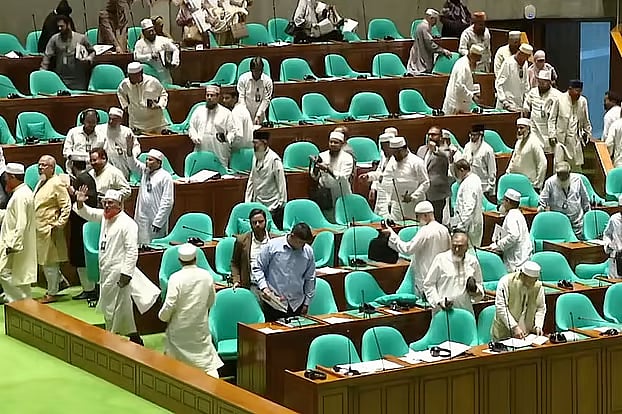
The opposition in Bangladesh’s 13th National Parliament is adopting a dual strategy of aggressive parliamentary engagement and street-level mobilisation to address pressing public concerns such as electricity and gas shortages, rising prices, and deteriorating law-and-order conditions. The Jamaat-e-Islami-led 11-party alliance has intensified its criticism of the Awami League government, accusing it of failing to implement reforms and address crises affecting daily life. Opposition lawmakers disrupted parliamentary proceedings last Thursday during a heated exchange with Home Minister Salahuddin Ahmed, highlighting their intent to hold the government accountable on key issues.
The opposition, led by Jamaat-e-Islami, is combining demands for political reform with grassroots mobilisation, including a nationwide long march starting on September 5. The alliance’s six-point agenda includes implementing the 2022 referendum verdict on state reforms, ensuring justice for victims of the July 2024 mass uprising, and addressing shortages of electricity, gas, fuel, and fertiliser, as well as rising commodity prices and law-and-order deterioration. Opposition leaders argue that the government has ignored public expectations since assuming office, prompting them to escalate protests from parliament to the streets.
Parliamentary sources revealed that the opposition had requested a special session to discuss the ongoing crises but was denied, leading to their decision to raise these issues through parliamentary proceedings. Opposition MPs claimed their reactions were spontaneous, particularly during a heated exchange with Home Minister Salahuddin Ahmed, while government-aligned sources described the opposition’s moves as premeditated. The opposition has vowed to continue challenging government statements that contradict public interest, including corruption allegations, in the coming days.
Jamaat-e-Islami leaders, including Amir Shafiqur Rahman and Secretary General Mia Golam Parwar, have framed the upcoming long march as a critical step toward broader political mobilisation. Rahman argued that the government has overlooked the referendum verdict, which he claimed received overwhelming public support, while Parwar warned that the alliance would not compromise on implementing the reforms. The alliance aims to build public opinion by addressing both governance failures and constitutional demands, positioning itself for a larger political movement.
The opposition’s programme includes long marches across four divisions—Chattogram, Rangpur, Khulna, and Sylhet—culminating in a grand rally in Dhaka. The first long march begins on September 5 in Dhaka, passing through Narayanganj, Cumilla, Feni, and concluding in Chattogram. Subsequent marches are scheduled for September 19 (Rangpur), October 31 (Khulna), and November 21 (Sylhet), with leaders from all 11 alliance parties expected to participate. Opposition coordinator Hamidur Rahman Azad stated that the campaigns would emphasise both reform implementation and public welfare concerns, aiming to rally broad public support.
Government critics argue that the Awami League administration has failed to deliver on promises of security and economic stability, contributing to widespread discontent. The opposition seeks to capitalise on public dissatisfaction by linking everyday hardships to systemic governance failures, framing their movement as a necessary corrective to unchecked executive power. With the long march and related programmes, the 11-party alliance aims to consolidate opposition voices and pressure the government into addressing the outlined demands.
#BangladeshPolitics #OppositionMovement #JamaatIslami #NationalParliament #LongMarch2024 #ReferendumVerdict #LawAndOrderCrisis #PublicProtests
Comments (0)
No comments yet — be the first to weigh in.

Mumbai’s Vile Parle Cypher is giving unheard rappers a voice
A new documentary streaming on YouTube sheds light on the Vile Parle Cypher, a grassroots hip-hop collective giving a platform to unheard street artists and gig...

Enrich and Ultimo impress
Racehorses Enrich and Ultimo Impress in Tuesday Morning Workouts at Bengaluru Turf Club BENGALURU, Sept 1 – Two rising stars in India’s horse racing circuit, En...

Karnataka CM Signals Review of 5% Park Land Amendment Bill in Assembly
Karnataka Chief Minister D.K. Shivakumar says the controversial 5% park land amendment bill can be re‑examined in the Assembly after protests over Lalbagh land use.

When an organisation deviates from its values, faith of those associated with its ideology is shattered: Kaushal Kishore
Former Union Minister and senior Bharatiya Janata Party (BJP) leader Kaushal Kishore suggested on September 1, 2026, that organizations risk losing public trust...
Mumbai’s Vile Parle Cypher is giving unheard rappers a voice
Enrich and Ultimo impress
Karnataka CM Signals Review of 5% Park Land Amendment Bill in Assembly
