NASA is gearing up to launch its next flagship space telescope – combining spy technology with sophisticated infrared detectors
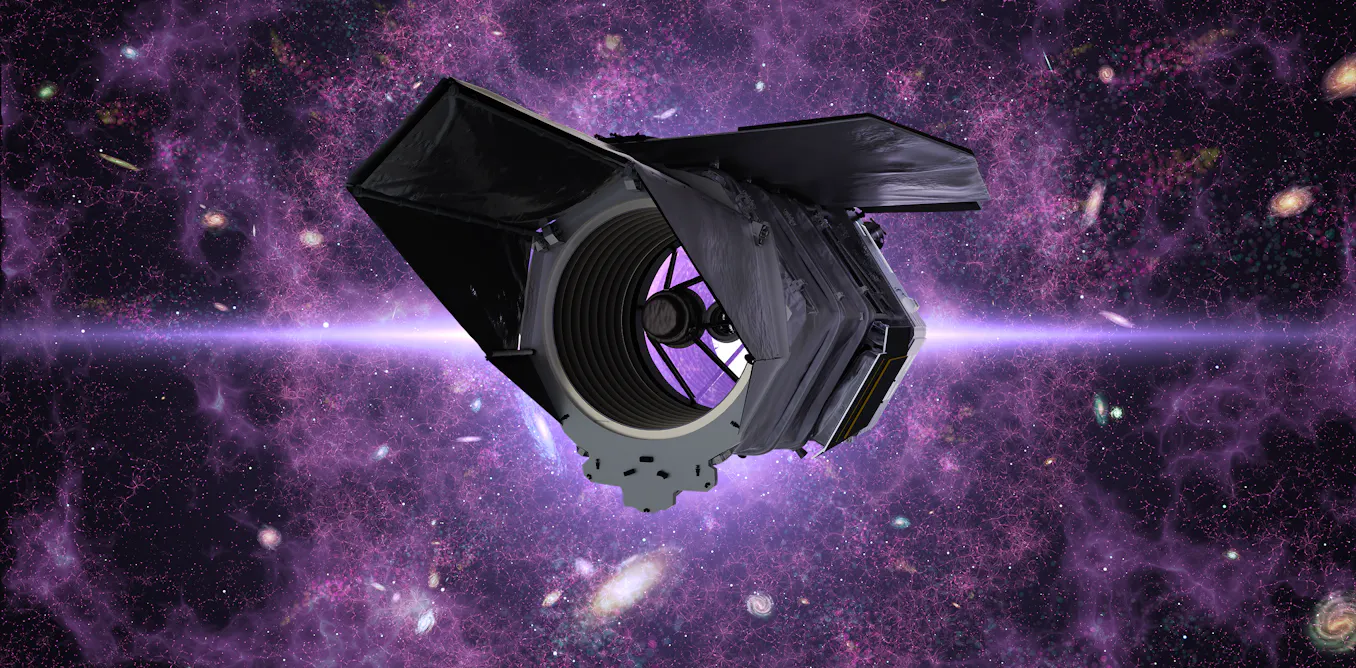
NASA is preparing to launch the Nancy Grace Roman Space Telescope, a next-generation observatory that blends advanced spy satellite technology with cutting-edge infrared detectors. Built from a repurposed spy telescope originally developed by the National Reconnaissance Office, Roman is set to survey a billion galaxies, map the distribution of dark matter, and study the universe’s expansion. The mission, currently scheduled for launch no earlier than August 30, 2026, marks a significant step in astrophysics and space exploration.
The Roman Space Telescope, named after NASA’s first chief astronomer, will operate from the second Lagrange point (L2), a stable orbital location about 1.5 million kilometers from Earth. Unlike the Hubble Space Telescope, which captures narrow, deep views of the cosmos, Roman will scan vast areas of the sky with unprecedented speed and sensitivity. Its wide field of view and advanced near-infrared detectors—18 sensors totaling 300 megapixels—enable it to observe faint, distant objects with clarity. These detectors, nearly identical to those on the James Webb Space Telescope but with four times the resolution, will help astronomers study dark energy, supernovae, and rogue planets.
One of Roman’s key scientific objectives is to investigate dark matter and dark energy, which together constitute most of the universe’s energy content but remain poorly understood. By measuring the three-dimensional distribution of dark matter and the expansion rate of the universe, astronomers hope to uncover clues about these mysterious components. Additionally, Roman will monitor stars near the center of the Milky Way, searching for gravitational microlensing events that reveal the presence of rogue planets drifting between stars. Its coronagraph instrument will also test new technology for directly imaging Earth-like planets around distant stars, a critical step toward future missions focused on habitability and life detection.
The telescope’s origins trace back to a 2012 transfer from the National Reconnaissance Office, which no longer required the hardware for its missions. NASA spent over a decade reconfiguring the spy telescope for civilian astronomical use, enhancing its wide-field capabilities while maintaining its robust optical design. This transformation highlights how dual-use technology can advance scientific discovery.
Roman’s detectors represent the culmination of decades of innovation. Early infrared detectors, developed in the 1970s, enabled groundbreaking discoveries, including the Nobel Prize-winning detection of dark energy in 2011. Subsequent advancements in infrared imaging have driven progress in black hole research and cosmology, setting the stage for Roman’s mission. As the telescope prepares for launch, scientists anticipate a new era of discovery, building on a legacy of technological breakthroughs that have reshaped our understanding of the universe.
NASA is already planning future missions, such as the Habitable Worlds Observatory, which aims to directly image Earth-like exoplanets. Until then, Roman stands poised to deliver transformative insights, reinforcing the cycle of innovation that has defined space exploration for generations.
#RomanSpaceTelescope #NASA #SpaceExploration #DarkMatter #Astrophysics #InfraredAstronomy #MilkyWay #NRO
Comments (0)
No comments yet — be the first to weigh in.

NASA Launches Nancy Grace Roman Telescope to Unlock Universe's Mysteries
NASA's new Nancy Grace Roman Space Telescope lifts off from Florida to study dark energy, exoplanets, and cosmic mysteries with unprecedented precision and scope.

Nature reserves spot rare species during heatwaves
Nature reserves in Hertfordshire and Middlesex have documented rare species this summer, with volunteers spotting wildlife not seen in decades and some even for...

Inmates at HMP La Moye craft boxes to save Jersey's hedgehogs
Prisoners at HMP La Moye have crafted nesting and feeding boxes to support Jersey's hedgehog population, boosting rehabilitation and community engagement.

2026 Nepal Flood: Ice‑Rock Avalanche, Glacial Lake Outburst and Climate‑Change Risks
A massive ice‑rock avalanche triggered a catastrophic flood in Nepal on Aug. 26 2026, followed by a glacial lake outburst that devastated towns and hydropower plants. Climate‑change‑driven thawing increased the risk.

Mumbai’s Vile Parle Cypher is giving unheard rappers a voice

Enrich and Ultimo impress

Karnataka CM Signals Review of 5% Park Land Amendment Bill in Assembly

