Britain's Railways Struggle with Soaring Temperatures and Derailments
Britain's rail network faces mounting challenges from extreme heat, causing derailments and service disruptions during record-breaking summers.
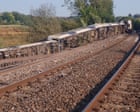
Britain's railways have faced significant heat-related challenges this summer, with two notable derailments occurring within days of each other. On July 18, a train derailed near Lewes in East Sussex, injuring 30 people, while the following day, the rear carriages of a Greater Anglia train derailed at Wickford station in Essex without any reported injuries. These incidents took place during one of the hottest and driest summers on record, with heatwaves and drought conditions affecting large parts of England and Wales. Network Rail, which manages Britain's rail infrastructure, acknowledged that the summer had presented "exceptional challenges to the railway."
Experts explain that modern railway tracks, which consist of long, welded steel sections, are particularly susceptible to heat. As temperatures rise, the rails expand, potentially causing them to buckle if they cannot accommodate the additional stress. According to William Powrie, a professor of geotechnical engineering at the University of Southampton, "The classic concern for railways with hot weather is that the track might buckle." The consequences can be severe, as seen in 2022 when almost 7,700 trains were canceled and an estimated £30 million in costs were incurred due to heat-related issues over just two days.
The soil beneath the tracks also poses a problem during hot, dry weather. Manu Sasidharan, an assistant professor of infrastructure asset management at University College London, noted that prolonged heat and drought can cause the soil to shrink, weakening its support for the track. This issue is exacerbated by the weight of passing trains, which can lead to uneven settlement. Some parts of Britain's rail network, including embankments, tunnels, and other structures, date back to the 1800s, further complicating efforts to address heat-related vulnerabilities.
To mitigate these issues, engineers in hotter countries often pre-stress rails, laying them slightly stretched so they have some give before expanding in the heat. In the UK, rails are pre-stressed to prevent compression until the air temperature exceeds 27°C, a compromise between the country's highest and lowest seasonal rail temperatures. However, this approach leaves rails more vulnerable to breaking in cold snaps, a trade-off that may become less sustainable as temperatures rise due to climate change.
Network Rail has explored various solutions, including painting sections of track white to reduce heat absorption—rails painted white are typically 5-10°C cooler—and potentially raising the stress-free temperature for modern, well-supported tracks from 27°C to 30°C. However, these measures are not without risks. Higher stress-free temperatures could leave rails more susceptible to damage during sudden cold snaps, and implementing such changes permanently may not be practical or cost-effective given Britain's variable climate.
Monitoring and maintaining the rail network during extreme weather remains a challenge. The Network Rail taskforce reported that fewer than half of the track buckles recorded in 2022 had been identified before they occurred. While modern trains are equipped with sensors that detect rough riding or unusual vibrations, sifting through the vast amounts of data generated is a significant hurdle. In the interim, temporary measures such as speed restrictions have been implemented in areas affected by derailments.
The Rail Accident Investigation Branch (RAIB) has not yet determined the exact cause of the Lewes derailment. An interim report identified a "track geometry irregularity" and noted reports of rough riding from passengers prior to the incident. Early evidence suggests a possible link to the track infrastructure, particularly given the embankment's clay foundation, which is prone to shrinking in dry conditions. Experts have noted that the location's design—a bend near a bridge—may have contributed to the failure, aligning with what safety experts call the "Swiss cheese" theory of accidents, where multiple small failures align to cause a significant incident.
Network Rail has stated that it is fully committed to supporting the investigation and implementing any lessons learned. A spokesperson emphasized that "safety is and will always remain our highest priority," acknowledging that while Britain's railway is one of the safest in the world, incidents like these require thorough examination to prevent future occurrences.
Comments (0)
No comments yet — be the first to weigh in.
Bentley Torcal: First All-Electric SUV Unveiling & Price Details
Bentley Motors will unveil its first all-electric SUV, the Torcal, on September 23. Discover pricing, features, and how it compares to competitors in the luxury EV market.

How King Harald V of Norway quietly led the world in clean tech adoption
King Harald V of Norway passed away in 2026 after a 35-year reign marked by stealth advocacy for clean technology, particularly electric vehicles, without political interference.

Why Gas Cars Could Be Worth Less Than Zero by 2031 in the US
Analyzing how cheap used EVs may make gasoline cars uneconomical in the US by 2031, with insights from Norway and China's used-car markets.

XPeng Advances AI Tech with VLA 2.0 Upgrade & Robotaxi Progress
XPeng's latest VLA 2.0 upgrade enhances intelligent driving with 4D perception, 20x safety boost, and voice-controlled robotaxis. Discover XPeng's AI advancements.

Mumbai’s Vile Parle Cypher is giving unheard rappers a voice

Enrich and Ultimo impress

Karnataka CM Signals Review of 5% Park Land Amendment Bill in Assembly

