Poland's Coal Decline Accelerates as Renewables Surge Past 50% in 2025
Poland's coal dependency drops from 72.5% to 52.7% in electricity generation, with renewables surpassing coal in June 2025. Gas also plays a growing role in the energy transition.
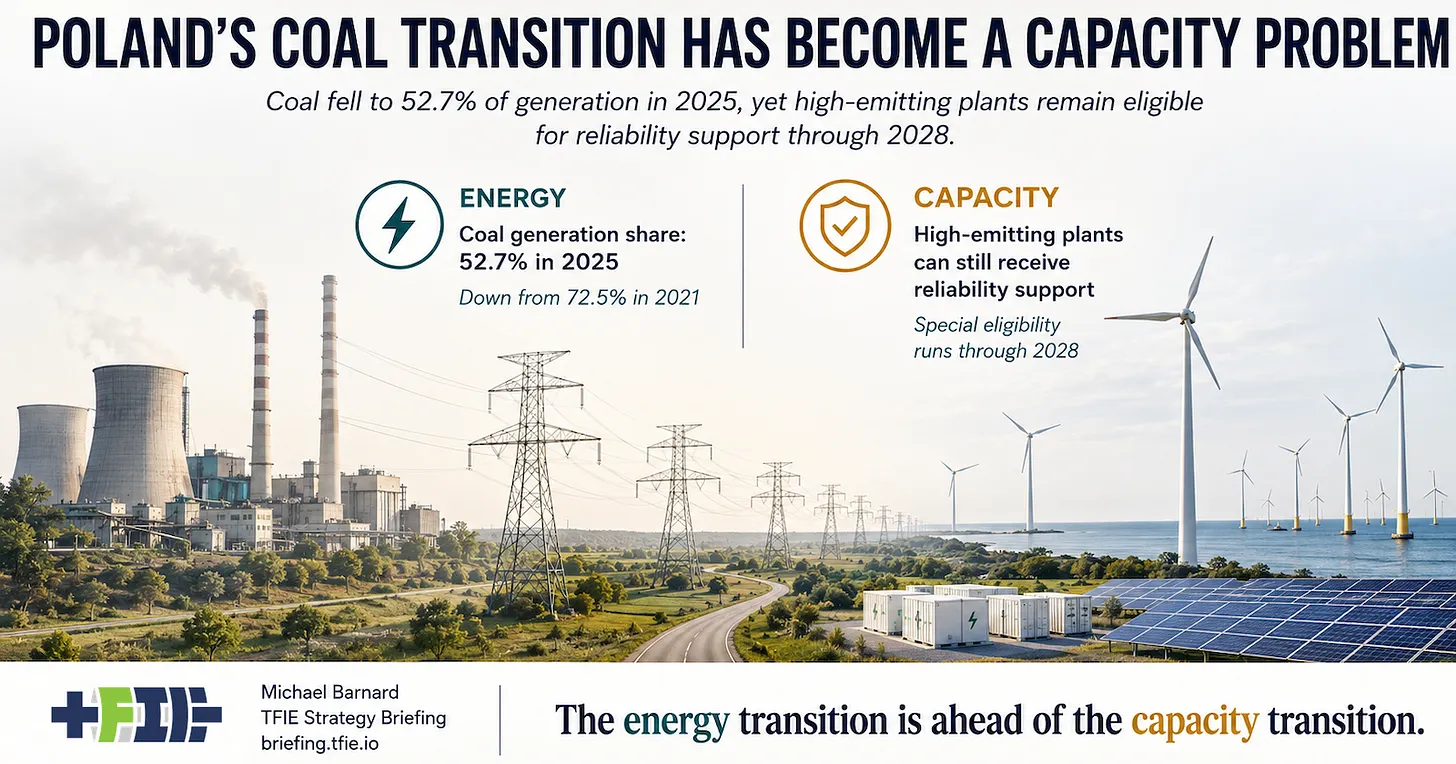
Poland is undergoing a rapid clean energy transition, significantly reducing its reliance on coal power while facing new challenges in grid reliability and capacity. Between 2021 and 2025, coal's share of Polish electricity generation dropped from 72.5 percent to 52.7 percent, while renewable energy sources reached 31.4 percent. Despite this shift, the country continues to maintain high-emitting coal facilities to ensure power system stability during peak demand hours.
The shift away from coal in Poland is not driven by green power alone. Natural gas generation has also expanded rapidly, accounting for 24.4 terawatt-hours of electricity in 2025 alongside 23.8 TWh from onshore wind and 20.3 TWh from solar power. This dynamic shows that Poland is replacing coal through a combination of renewables and natural gas rather than relying entirely on zero-emission energy sources.
While coal generation is falling, Polish energy policymakers face a growing gap between overall energy generation and reliable grid capacity. To maintain backup power during periods of low wind, low solar output, or peak electricity demand, Poland continues to fund coal plant availability. In a September 2025 supplementary capacity auction for the 2026 delivery year, the country contracted 7.58 gigawatts of capacity obligations. High-emitting plants producing over 550 grams of carbon dioxide per kilowatt-hour were allowed to participate under a special European Union derogation, with similar auctions planned through 2028 when the EU exemption expires.
This divergence between falling generation and required standing capacity highlights structural grid challenges. In 2025, Poland curtailed 1.4 TWh of renewable power, which was double the amount from 2024. The curtailment occurred primarily due to system balancing constraints rather than physical transmission line congestion. The influx of low-cost solar and wind energy occasionally exceeds what the country's legacy infrastructure can absorb, even as backup coal plants remain necessary for times of low renewable generation.
Modernizing the grid requires significant investment in energy storage, transmission lines, international interconnectors, and flexible demand response. Major infrastructure additions are already coming online to address these needs. Poland's first offshore wind project, Baltic Power, began delivering electricity to the national grid in July 2026. Once fully operational, the 1.2 GW facility is expected to generate roughly 4 TWh annually, representing about 3 percent of total Polish electricity demand.
The International Energy Agency projects that Polish renewable energy generation will grow approximately 13 percent annually through 2030, officially surpassing coal on an annual basis in 2028. By 2030, renewables are expected to generate 53 percent of Polish electricity, while coal generation drops by roughly 11 percent per year.
Poland's energy sector highlights two distinct aspects of the transition: phasing coal out of the annual generation mix is moving quickly, but fully retiring high-emitting capacity while maintaining grid reliability remains a complex challenge.
#Poland #EnergyTransition #CoalPower #RenewableEnergy #CleanEnergy #BalticPower #GridDecarbonization
Comments (0)
No comments yet — be the first to weigh in.

Bentley Torcal: First All-Electric SUV Unveiling & Price Details
Bentley Motors will unveil its first all-electric SUV, the Torcal, on September 23. Discover pricing, features, and how it compares to competitors in the luxury EV market.

How King Harald V of Norway quietly led the world in clean tech adoption
King Harald V of Norway passed away in 2026 after a 35-year reign marked by stealth advocacy for clean technology, particularly electric vehicles, without political interference.

Why Gas Cars Could Be Worth Less Than Zero by 2031 in the US
Analyzing how cheap used EVs may make gasoline cars uneconomical in the US by 2031, with insights from Norway and China's used-car markets.

XPeng Advances AI Tech with VLA 2.0 Upgrade & Robotaxi Progress
XPeng's latest VLA 2.0 upgrade enhances intelligent driving with 4D perception, 20x safety boost, and voice-controlled robotaxis. Discover XPeng's AI advancements.

Mumbai’s Vile Parle Cypher is giving unheard rappers a voice

Enrich and Ultimo impress

Karnataka CM Signals Review of 5% Park Land Amendment Bill in Assembly

